Posted by revengeofareasonablemind in National Security, Political Commentary.
Though President Obama’s “strategy” has been met with fusillade of commentary ranging from those loyal-to-a-fault sycophants who gushed how the President could not be more on the mark and insightful to those who opine that the Administration’s strategy is a confusing rehash of a random assortment of words that muddy whatever the policy is for dealing with Daesh, even more than it is muddied already; if that’s possible. The most recent nexus of events where Iran has gotten involved with defeating Daesh or rather asserting military influence in Iraq (albeit not particularly effectively) to the consternation of the U.S., presents President Obama with a real dilemma. The U.S. provided air support to the Iraqis in taking back the Iraqi town of Tikrit. But, the Iranians were allied with the Iraqi’s. So, we were providing air support to the Iranians, as well. Now, let’s look at Yemen. The Yemeni Houthi rebels have all but over thrown the government of Yemen. We don’t want the government of Yemen overthrown and back the efforts of the Saudis and the Arab “Coalition” to destroy the Houthi rebels who are supported by Iran. Meantime, Secretary Kerry is excited that he and his team are negotiating with Iran (number one state sponsor of terrorism) to stop Iran from building atomic bombs. All of this, makes the Obama Strategy for dealing effectively with Daesh difficult to follow. At any rate amidst the warring points of view, none being particularly compelling, the confusions about who’s side we should be supporting and why, I thought that the subject of the “strategy” was deserving of a yet-to-be-heard clear recommendation and the revenge of a reasonable mind.
First, I think it is accurate to say that what got everyone off to bad start were the President’s comments back in September 2014 at the National Defense University, never mind the avalanche of mixed messages leading up to the speech, when used the word “strategy.” Obama in his remarks did start the strategy discussion in a reasonable albeit small ball way. He said the Administration’s “objective” was to “degrade and defeat” Daesh. But, then he explained that there were four parts to the U.S. strategy.
- A systematic campaign of airstrikes against ISIL [Daesh]
- Increased support to forces fighting ISIL [Daesh] (Aside: I don’t believe that Obama anticipated that this included Iran)
- Drawing on our substantial counterterrorism capabilities to prevent ISIL [Daesh] attacks
- Providing humanitarian assistance to innocent civilians displaced by ISIL [Daesh]
What appears to be the case here is that the four parts to the strategy look more like tactics or actions that the U.S. would be expected to take anyway, along with a significant number of others not mentioned that would be effective, ultimately, in eliminating radical Islamic jihadism from existence. The actions are limited in scope, addressing a very regionalized manifestation of a more global phenomenon that threatens the U.S. and it friends and allies. I think people were expecting a strategy to deal with Daesh in the broadest sense of the word “strategy” on the order of the strategy implemented during World War II when the U.S. chose a Europe First course of action. The reason that it was a strategy was that it made very clear the way ahead, was actionable and established the foundation for integrated tactics both operational and logistical. The four-part “strategy” the Obama Administration has offered up falls somewhere way short of being an integrated course of action that meets the “Europe First” standard.
Let’s look at what a more effective “strategy” might look like. We need a strategy statement that in the broadest sense incorporates the objective that Administration offered, “degrade and defeat” Daesh, but one that addresses the more pervasive problem of global Islamic fanaticism that leads to terrorism. I recommend the following: “The United States is committed to using its considerable world wide physical presence, its matchless military strength, its economic reach and diplomatic prowess to eliminate those individuals and organizations who would prostitute and use the Islamic religion to pursue terrorism or other hostile intent and represent a real, active and persistent threat to the U.S. national security and U.S. citizens wherever they may be.” Now, I suspect the first thing someone will say is, “well you can’t hope to eliminate the Islamic jihadist threat completely.” Ok, but if you have that as your strategy statement, you will muster the resources and focus them i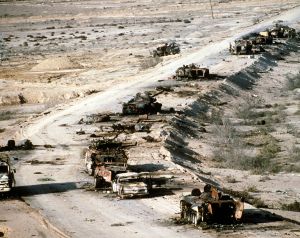 n way where you might come close. In any event you will be on the right strategic path. With out the breadth of such a strategy statement, we run the risk of aiming too low, like Obama did. With our strategy statement fleshed out, the U.S. strategy to achieve the objectives inherent in the statement should be. The Middle East and Africa will be where we will focus our efforts first. This strategy forms the basis for more pragmatic and effective actions or tactics. We aren’t just employing what the Administration calls a “systematic campaign of airstrikes.” Eliminate means we want our airstrikes against Daesh to mirror the effects of U.S. airstrikes in DESERT STORM (see the photo of the “Highway of Death” leading out of Kuwait in 1991). Please note that nothing moved once the Iraqi convoys became targets. Highway 1 leading from Mosul to Syria should look just like the “Highway of Death.” We know what an annihilating air campaign looks like and we must not be hesitant to engage the Daesh enemy with that level of persistent air power. The problem with airpower, however, is that it is only part of kinetic enemy engagement equation. Like it or not, fighter pilots can drop bombs, shoot rockets and pull Gs until their G-suits squeeze them silly, but if there isn’t a soldier with his rifle advancing to, standing on and defending a square meter of ground, we haven’t won anything. The U.S. must deploy sufficient ground forces to effectively deal with Daesh in Iraq, with the understanding that redeployment will happen when we’ve achieved the goal of every Daesh fighter being eliminated from being a threat….ever. No time limit, just a clear understanding by all involved what the end of hostilities looks like. What is missing from the Obama list of actions, is what the outcome or goal will be. The end state of our bombing campaign has to be that no Daesh fighter can reasonably expect to come out from hiding, day or night, be able to move, or in anyway reveal themselves without dying a quick and violent death. No reinforcements or supplies or logistics support of any kind can reach the Daesh strongholds. Armies must be resupplied and the Daesh is no different. Stop there supplies. For Daesh in Iraq there can be only two alternatives, give up the will to continue fight or be dead. Either way it should not matter to us.
Committing the U.S. economic reach means that there isn’t a bank or investment account anywhere in the world that would or could support Daesh, Al Qaeda, Al-Shabbab, Boca Haram or any other version of Islamic Jihadist extremism. They all would be frozen. A more effective approach would be to simply drain the accounts of the money and give it as reparations to those who have been terrorized. People or organizations who want to continue to funnel money to Islamic terrorist groups also risk the same fate as the Daesh fighters in Tikrit and Mosul. We have the capability to employ covert actions against people and organizations world wide. Let’s use it. These objectives and strategy require that the Administration does something that up until now it has not had an appetite for, or at least failed to do. The U.S. must employ the immense capability we have to attack and defeat the psychology of the terrorist. The Islamic terrorists believe that sacrificing themselves to achieve their distorted view of Allah’s will is the end state that is their divine mission. Many young Muslim men and women in Europe and the U.S. have the mistaken notion that their personal jihad is to join the Daesh in this glorious religious, righteous crusade. We want them to realize beyond a shadow of a doubt that attempting to achieve their goal will result simply in their end. Start to feed the social media that they watch so closely with the absolutely certain ignominious and brutal end that they will meet. Make it clear that whatever winning means to them is simply not possible in the face of the overwhelming power of the U.S. on all fronts. But, under no circumstance give them hope of accomplishing their purpose.
Lastly, our diplomatic strength must be focused on our allies in Europe to convince them that their active participation in this war against Islamic radical jihadists is the only way of reducing the peril for their citizens. We must use our diplomatic leverage to convince the Middle Eastern friendly nations that our purpose is to create less hostile environment for them as well. They have a stake in the outcome. In the end our strategy and tactical objectives must demonstrate that the United States understands that we are at war with fanatical Islamic terrorists and jihadists. They declared the war and we must realize it and fight with the immense capability at our disposal on all fronts.

 revengeofareasonablemind
Strategy Tragedy: Obama Administration Deals with ISIS or ISIL April 25, 2015
Posted by revengeofareasonablemind in National Security, Political Commentary.add a comment
We know a great deal (not to be confused with the out come of the negotiations with Iran, which is not a “great deal”) from the Administration about their “strategy” for engaging the Islamic State of Iraq and Syria (ISIS) or Islamic State of Iraq and the Levant (ISIL). Let’s just call these creatures Daesh, since as Zeba Kahn points out in the October 9th edition of the Boston Globe, “The term ‘Daesh’ is strategically (and we are talking about strategy here) a better choice because it is still accurate in that it spells out the acronym of the group’s full Arabic name, al-Dawla al-Islamiya fi al-Iraq wa al-Sham. Yet, at the same time, ‘Daesh’ can also be understood as a play on words — and an insult.” But, as they say, “I digress.”Though President Obama’s “strategy” has been met with fusillade of commentary ranging from those loyal-to-a-fault sycophants who gushed how the President could not be more on the mark and insightful to those who opine that the Administration’s strategy is a confusing rehash of a random assortment of words that muddy whatever the policy is for dealing with Daesh, even more than it is muddied already; if that’s possible. The most recent nexus of events where Iran has gotten involved with defeating Daesh or rather asserting military influence in Iraq (albeit not particularly effectively) to the consternation of the U.S., presents President Obama with a real dilemma. The U.S. provided air support to the Iraqis in taking back the Iraqi town of Tikrit. But, the Iranians were allied with the Iraqi’s. So, we were providing air support to the Iranians, as well. Now, let’s look at Yemen. The Yemeni Houthi rebels have all but over thrown the government of Yemen. We don’t want the government of Yemen overthrown and back the efforts of the Saudis and the Arab “Coalition” to destroy the Houthi rebels who are supported by Iran. Meantime, Secretary Kerry is excited that he and his team are negotiating with Iran (number one state sponsor of terrorism) to stop Iran from building atomic bombs. All of this, makes the Obama Strategy for dealing effectively with Daesh difficult to follow. At any rate amidst the warring points of view, none being particularly compelling, the confusions about who’s side we should be supporting and why, I thought that the subject of the “strategy” was deserving of a yet-to-be-heard clear recommendation and the revenge of a reasonable mind.
First, I think it is accurate to say that what got everyone off to bad start were the President’s comments back in September 2014 at the National Defense University, never mind the avalanche of mixed messages leading up to the speech, when used the word “strategy.” Obama in his remarks did start the strategy discussion in a reasonable albeit small ball way. He said the Administration’s “objective” was to “degrade and defeat” Daesh. But, then he explained that there were four parts to the U.S. strategy.
What appears to be the case here is that the four parts to the strategy look more like tactics or actions that the U.S. would be expected to take anyway, along with a significant number of others not mentioned that would be effective, ultimately, in eliminating radical Islamic jihadism from existence. The actions are limited in scope, addressing a very regionalized manifestation of a more global phenomenon that threatens the U.S. and it friends and allies. I think people were expecting a strategy to deal with Daesh in the broadest sense of the word “strategy” on the order of the strategy implemented during World War II when the U.S. chose a Europe First course of action. The reason that it was a strategy was that it made very clear the way ahead, was actionable and established the foundation for integrated tactics both operational and logistical. The four-part “strategy” the Obama Administration has offered up falls somewhere way short of being an integrated course of action that meets the “Europe First” standard.
Let’s look at what a more effective “strategy” might look like. We need a strategy statement that in the broadest sense incorporates the objective that Administration offered, “degrade and defeat” Daesh, but one that addresses the more pervasive problem of global Islamic fanaticism that leads to terrorism. I recommend the following: “The United States is committed to using its considerable world wide physical presence, its matchless military strength, its economic reach and diplomatic prowess to eliminate those individuals and organizations who would prostitute and use the Islamic religion to pursue terrorism or other hostile intent and represent a real, active and persistent threat to the U.S. national security and U.S. citizens wherever they may be.” Now, I suspect the first thing someone will say is, “well you can’t hope to eliminate the Islamic jihadist threat completely.” Ok, but if you have that as your strategy statement, you will muster the resources and focus them i n way where you might come close. In any event you will be on the right strategic path. With out the breadth of such a strategy statement, we run the risk of aiming too low, like Obama did. With our strategy statement fleshed out, the U.S. strategy to achieve the objectives inherent in the statement should be. The Middle East and Africa will be where we will focus our efforts first. This strategy forms the basis for more pragmatic and effective actions or tactics. We aren’t just employing what the Administration calls a “systematic campaign of airstrikes.” Eliminate means we want our airstrikes against Daesh to mirror the effects of U.S. airstrikes in DESERT STORM (see the photo of the “Highway of Death” leading out of Kuwait in 1991). Please note that nothing moved once the Iraqi convoys became targets. Highway 1 leading from Mosul to Syria should look just like the “Highway of Death.” We know what an annihilating air campaign looks like and we must not be hesitant to engage the Daesh enemy with that level of persistent air power. The problem with airpower, however, is that it is only part of kinetic enemy engagement equation. Like it or not, fighter pilots can drop bombs, shoot rockets and pull Gs until their G-suits squeeze them silly, but if there isn’t a soldier with his rifle advancing to, standing on and defending a square meter of ground, we haven’t won anything. The U.S. must deploy sufficient ground forces to effectively deal with Daesh in Iraq, with the understanding that redeployment will happen when we’ve achieved the goal of every Daesh fighter being eliminated from being a threat….ever. No time limit, just a clear understanding by all involved what the end of hostilities looks like. What is missing from the Obama list of actions, is what the outcome or goal will be. The end state of our bombing campaign has to be that no Daesh fighter can reasonably expect to come out from hiding, day or night, be able to move, or in anyway reveal themselves without dying a quick and violent death. No reinforcements or supplies or logistics support of any kind can reach the Daesh strongholds. Armies must be resupplied and the Daesh is no different. Stop there supplies. For Daesh in Iraq there can be only two alternatives, give up the will to continue fight or be dead. Either way it should not matter to us.
Committing the U.S. economic reach means that there isn’t a bank or investment account anywhere in the world that would or could support Daesh, Al Qaeda, Al-Shabbab, Boca Haram or any other version of Islamic Jihadist extremism. They all would be frozen. A more effective approach would be to simply drain the accounts of the money and give it as reparations to those who have been terrorized. People or organizations who want to continue to funnel money to Islamic terrorist groups also risk the same fate as the Daesh fighters in Tikrit and Mosul. We have the capability to employ covert actions against people and organizations world wide. Let’s use it. These objectives and strategy require that the Administration does something that up until now it has not had an appetite for, or at least failed to do. The U.S. must employ the immense capability we have to attack and defeat the psychology of the terrorist. The Islamic terrorists believe that sacrificing themselves to achieve their distorted view of Allah’s will is the end state that is their divine mission. Many young Muslim men and women in Europe and the U.S. have the mistaken notion that their personal jihad is to join the Daesh in this glorious religious, righteous crusade. We want them to realize beyond a shadow of a doubt that attempting to achieve their goal will result simply in their end. Start to feed the social media that they watch so closely with the absolutely certain ignominious and brutal end that they will meet. Make it clear that whatever winning means to them is simply not possible in the face of the overwhelming power of the U.S. on all fronts. But, under no circumstance give them hope of accomplishing their purpose.
Lastly, our diplomatic strength must be focused on our allies in Europe to convince them that their active participation in this war against Islamic radical jihadists is the only way of reducing the peril for their citizens. We must use our diplomatic leverage to convince the Middle Eastern friendly nations that our purpose is to create less hostile environment for them as well. They have a stake in the outcome. In the end our strategy and tactical objectives must demonstrate that the United States understands that we are at war with fanatical Islamic terrorists and jihadists. They declared the war and we must realize it and fight with the immense capability at our disposal on all fronts.